You know what I’d love to see this year? A board game about sneaking
into a fortress as a ninja in feudal Japan.
Ah, if only that was happening.
Oh, shit! Wait! Not only is it happening, we’re getting two competing
ones. Fight! Fight! Fight!
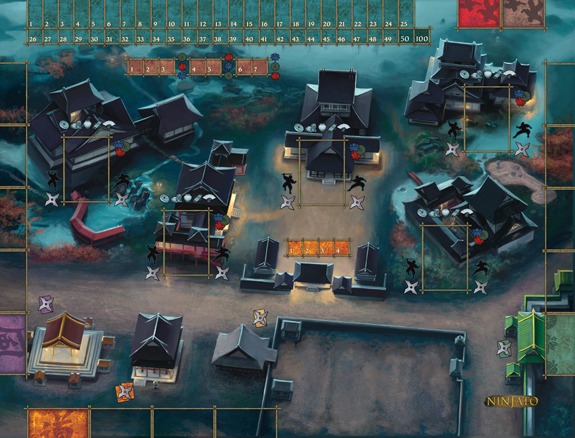
First up, let me introduce you to Ninjato from Z-Man games. That’s the
board you can see above, but we can do one better than that. As is
pretty common practice in board gaming, the rules have already been
released online.
Since I am nosy to the point of being nothing more than a massive nose,
I’ve had a look. It’s by far the simpler and more accessible of the two
games, and it’s also a bit abstract. In short, all the players are
ninjas out to score the most honour so they’ll become the honourable
Invisible Sword of the honourable ruling house. Aren’t ninjas meant to
be entirely dishonourable? SILENCE, is what this game would say if it
could talk.
Anyway, the players are also competing so they won’t have to be the one
who packs away the game. That’s actually in the manual, right there on
page 10. My favourite bit in the manual, though, is in all capitals on
page 4: “YOU INVADE HOUSES TO EARN TREASURE." Yep, that sounds
honourable alright.
On your turn you can either train at the dojo or get the wise sensei to
teach you a skill, both of which aid your HOUSE INVASIONS, or you can
use your turn to spend your hard-earned HOUSE INVASION TREASURE to bribe
envoys or spread rumours, both of which increase your HOUSE INVASION.
Sorry, I mean your honour.
Ninjato sounds interesting enough, but relatively simple games like this
one have a habit of being a lot more interesting to play than they are
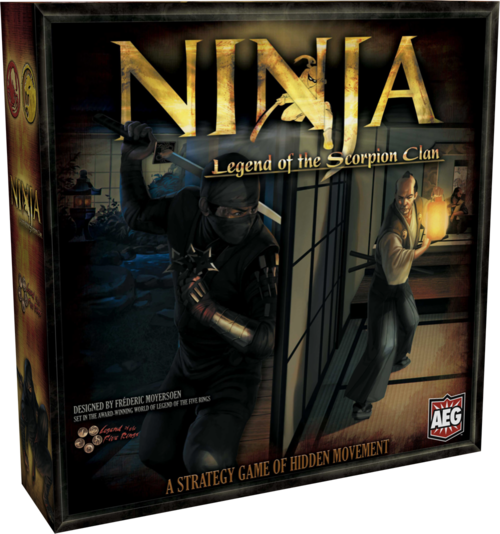
to read about. As such, I’m currently far more pumped about AEG’s
upcoming game Ninja: Legend of the Scorpion
Clan.
Oof! That’s some box art, right there.
"Ninja features fast play, hidden movement, limited information, bluff
and guile," say AEG.
"Holy shit," says me. “Sign me up!"
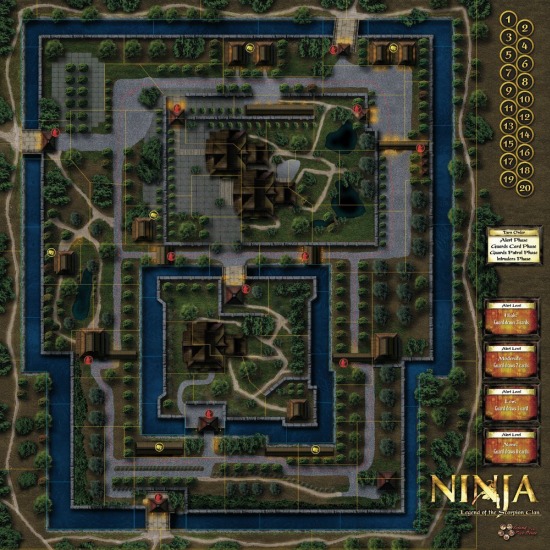
No abstraction here. Just one long night, with one or two players
controlling a ninja or two who descend on a fortress to accomplish a
nefarious, randomised objective, and one or two players controlling the
guards.
The ninjas are armed with climbing ropes, drugged sake, shurikens and
more besides, but they also have the deadliest weapon of them all: the
element of surprise. Urgh, that was awful. I’m sorry. The point is that
it’s only once trace of a ninja is detected (you know, finding
droppings, hearing their mating cries, etc.) that the guard players can
start advancing through increasingly useful alarm levels.
The reason the guard player might have trouble finding the ninja is
because of that whole “hidden movement" thing. What hidden movement
means is that the ninja players won’t place their figures on the board,
instead marking their progress using a miniaturised map of their own.
Guards will have to wander around, searching for any trace of a ninja in
a murderous game of hide and seek. Hidden movement is a mechanic that’s
appeared in dozens of game prior to this one (first showing up in a game
called Scotland
Yard and
most recently in gorgeous Jack the Ripper-hunting game Letters From
Whitechapel),
but that’s no reason to not be excited. This idea positively steals any
game it appears in. It’s that good.
You want ANOTHER reason to be excited about Ninja: Legend of the
Scorpion Clan?
Are you this demanding to your friends and family? OK, OK.
In a three player game, the third player gets to play a traitor on the
guard team whose true loyalty lies with the Scorpion Clan. AEG have
released almost no information about how this’ll work, except that the
traitor can act either co-operatively or competitively against the
ninja, and he’ll play very differently to either side. That has got to
be great fun to play. Asymmetry in game design is like heat in a curry.
It just makes things better.
You’d better believe we’ll be bringing you some reviews just as soon as
these games hit the shelves. Almost certainly with Paul dressed as a
ninja, trying to sneak down a crowded street.
— Quinns